




|
Digital Occlusion Problems |
|
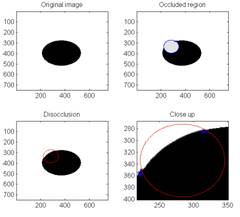
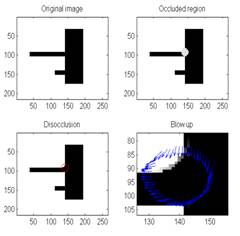
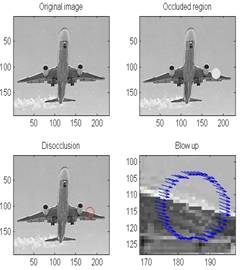
My recent work (with Rob Hladky) on minimal surfaces in the roto-translation group provides a new framework for filling in occluded regions within digital images using the same process as the first layer of the visual cortex uses in the brain (at least according to the model). Initial work, again with Hladky, has produced an implementation of this algorithm that, when it works, is significantly factor than known algorithm (the images on the right show examples of the algorithm at work). However, there are still a number of situation where the algorithm performs poorly or fails altogether. These seem to occur when the mathematical model produces multiple possible completions or partial completions — we are currently missing a plausible way to make choices and/or combine the various choices into a single completion. This is related to the problem, described in the section on “Minimal surfaces in the roto-translation group”, regarding non-smooth minimal surfaces and gluing operations. Projects in this area might include:
1. Experimental combination of multiple completions to look for examples of non-smooth completions. 2. Revamping existing algorithms to add new features of the occlusion problem and/or improve efficiency.
Experience and requirements: Students interested in this area should have completed at least math 13 (or its equivalent) and have an interest in digital image manipulation. Experience with matlab coding would be helpful as all of the implementations of the algorithm have, to this point, been in matlab. |