


|
Sub-Riemannian geometries |
|
One way to characterize a geometric space is to describe how far each point is from every other point. In Euclidean three dimensional space (the world we are most familiar with), we intuitively know that from any point we can reach any other point the fastest by following the straight line between those two point. The straight lines in this setting are called geodesics — they are the shortest paths between the two points that they connect.
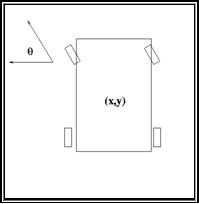
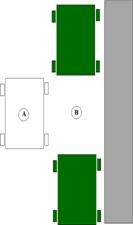
Sub-Riemannian geometries arise when we have a situation where, for some reason, we do not allow travel in certain directions. While this might seem strange, it arises quite often in physical problems. Consider, for example, driving a car. We can describe the “state” of the car using three variables. First, we have the position of the car given by a point in the two dimensional plane, denoted by (x,y) . Second, If we think about which direction the car will travel if we step on the gas, we need to know the position of the steering wheel. As the steering wheel rotates the front wheels, we will denote the angle of the front wheels with the axis of the car by θ (see the figure on the right). In this situation, we can see the constrained motion most naturally by thinking about pulling into a parking spot. In the second figure on the right we see the situation—the car can not most sideways in one step, but through a combination of turning the wheel and moving forward and backwards, the car can manuver into the spot. Thus, from the point of view of the car moving from point A to B (in the figure) the distance is longer than the striaght line distance. This description of distance characterizes the sub-Riemannian geometry of this example. |
|
Description of a car in terms of (x,y,θ) |
Limited degrees of freedom |

|
Parallel parking |