I study evolutionary dynamics and how the population structure influences the spread of strategies or variants.
The same rules govern the spread of genetic variants in a population, opinions in a social network, and information in distributed protocols: individuals interact locally, randomness plays an important role, and the structure of possible interactions influences the outcome. I prove results about outcomes of the evolutionary dynamics, such as fixation probabilities, coexistence and fixation times, and thresholds for cooperation. I am interested in formal methods and applications to machine learning and artificial intelligence. I explore distributed algorithms with application to blockchains and liquid democracy.
I am a postdoc at Dartmouth, in the math department, working with Santiago Schnell. Before that, I was a postdoc and a PhD student at ISTA with Krishnendu Chatterjee.
My research
Evolutionary processes
Whenever two people meet, they can either cooperate or defect and afterwards, based on the results of these interactions, they can update their strategies. Mathematical formalizations of these processes apply to many domains, such as bacteria or social dynamics. I study how the population structure influences the spread of cooperation. In Density amplifiers of cooperation for spatial games and Promoters of cooperation in evolutionary games, both published in PNAS, we designed population structures that promote cooperation in a range of settings.
In evolutionary processes, an individual’s fitness can depend on the position in the network. For instance, it might be influenced by a distance from a source of nutrients. The effects of heterogeneity are not monotone. In The effect of the fitness gradient on fixation probability, published in Nature Communications, we studied a mutant whose mean fitness equals that of the residents and found three regimes: a negligible gradient leaves the fixation probability at the neutral order 1/N, a small gradient raises it to the order of the gradient, and a sufficiently large gradient makes it vanish with population size.
A related question is not which type wins but how long the alternatives survive. We derived bounds showing how migration between two patches controls the coexistence time (Proceedings of the Royal Society A), and, starting from a distinct type at every vertex, exact asymptotic diversity times for standard graph families together with directed constructions on which diversity persists for superexponentially long (PNAS Nexus).
Many evolutionary processes depend on a microscopic update rule: one rule can represent reproduction in a resource-rich environment and another in a resource-constrained one. These rules can completely change the effects of the structure. Therefore, I'm interested in robust structures that guarantee the desired effect no matter the update rule. we constructed the first networks that amplify selection under both rules simultaneously, and proved limits on how much can be gained under the two at once in Amplifiers of selection for the Moran process with both Birth-death and death-Birth updating published in PLOS CB.
Formal methods and learning
In evolutionary dynamics, I usually analyse a random process represented as a large Markov chain (directed graphs where, from one state or vertex, there is a distribution over the next states). In formal methods, two adversarial players are added that control some states. Finding the optimal strategy for any player is a notoriously hard problem. We solved important subproblems of this problem. In SODA'23, we created a new algorithm for reachability in stochastic games with bounded treewidth. The algorithm is quasipolynomial for the bounded treewidth. It also runs in subexponential time on the instance families that force previous state-of-the-art algorithms to take exponentially many steps. In LICS 2024, we gave the first deterministic subexponential algorithm for discounted-sum games when the edge weights are in unary.
These models are foundational for reinforcement learning, so I applied formal methods to learning with guarantees. Learning from a reachability specification has no discount factor, so the standard convergence arguments do not apply. We proved PAC guarantees for such objectives in Reinforcement learning from reachability specifications and, more recently, asymptotic optimality in Reinforcement learning for reachability, both published at ICML. Moreover, I am interested in where the hardness of these problems actually sits: in Linear equations with min and max operators (AAAI 2025) we reformulated stochastic games as an algebraic problem and studied its complexity, which is a way of asking which restrictions admit efficient algorithms and which are as hard as the general case.
Distributed computing
I am also interested in algorithms for decentralized systems, where the same structural questions appear with strategic participants instead of reproducing individuals. One such model is liquid democracy: every voter can either vote directly or delegate to a better-informed neighbor. Delegation concentrates the votes, which raises the variance of the outcome, so it can help or hurt depending on how competence is distributed. In When is liquid democracy possible? (PODC 2025) we study when delegation beats direct voting by treating it as manipulation of that variance.
Other distributed problems come from payment channel networks. There, vertices try to maximize the amount of value that can flow through a network. We gave online admission control that improves liquidity (FC 2023), studied which channels to open and which transactions to select (DISC 2025), settled the complexity of weighted packet selection for rechargeable links and gave approximation algorithms for it (Theoretical Computer Science, best paper award at SIROCCO 2023), and showed how routes can be discovered when the channel balances are private (ESORICS 2024).
Teaching and supervision
I led practicals in algorithms and data structures, in discrete mathematics, and in combinatorics and graph theory at Charles University. I was a teaching assistant for formal methods at ISTA. I have supervised four student projects, three of which became peer-reviewed papers.
- Soham Joshi: amplifiers for Birth-death and death-Birth updating; published in PLOS Computational Biology
- Esra Ceylan: congestion-free rerouting of network flows; published at NOMS 2024
- Mahsa Bastankhah: liquidity in payment channel networks; published at FC 2023
- Sebastian Haslebacher: stochastic games
Service and recognition
- Program committee: AAAI 2026
- Reviewing: Nature Communications, Nature Computational Science, Journal of Theoretical Biology, PLOS Computational Biology, Information and Computation, LICS, MFCS
- Best paper: SIROCCO 2023
Interests
I love to read, check some of the books I read on Goodreads.
I was involved in organizing Math Camp in Austria.
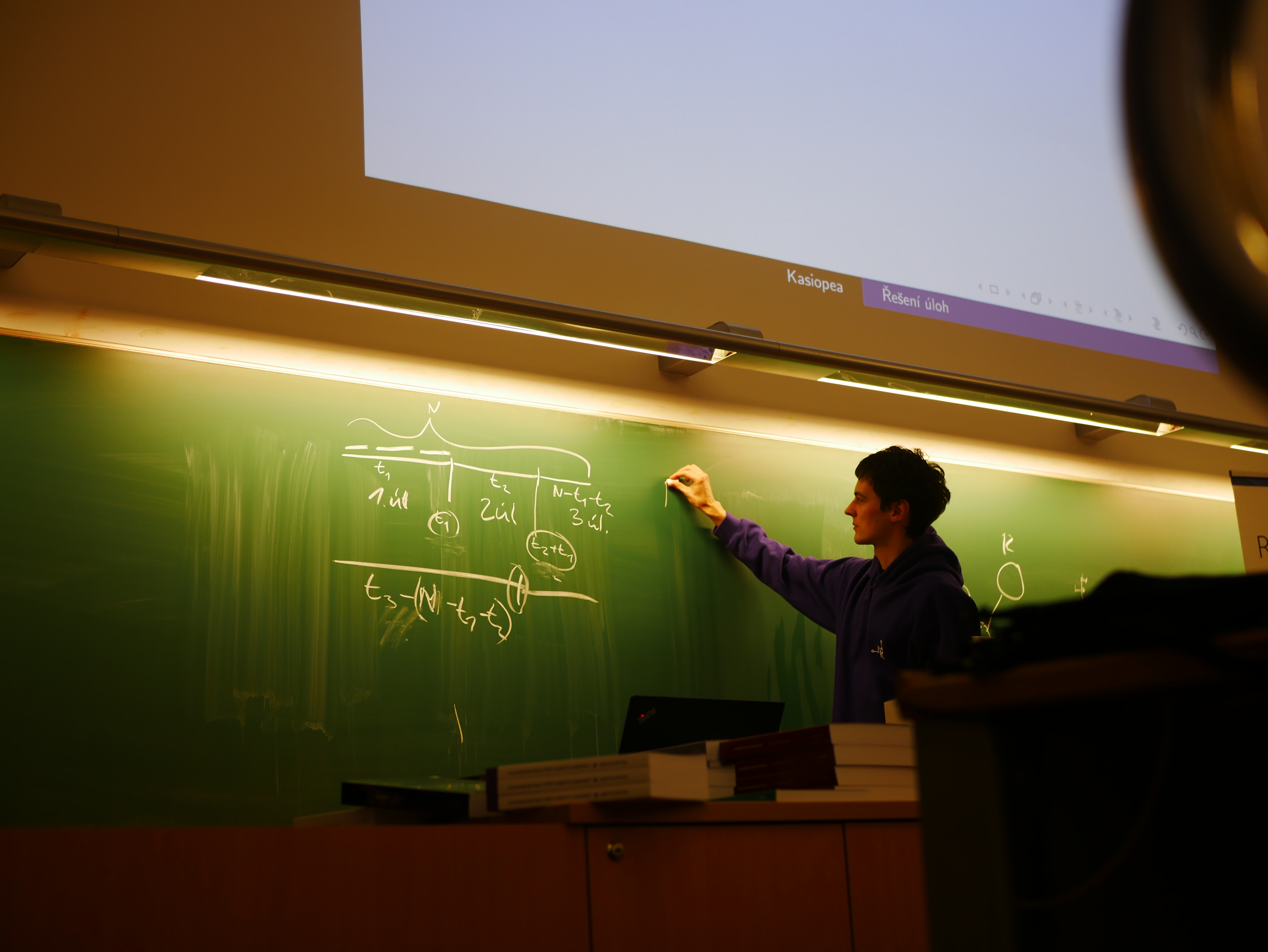
I organized and led Kasiopea, a programming competition for high school students.